
Torp Sandefjord Lufthavn has its own AI assistant, TorpAI, on torp.no – and its answers are based on flight data as it is right now. TorpAI is coreAI under Torp's own name and design: coreAI is the supplier of the platform behind the chat, and fetches the flight data through the Model Context Protocol (MCP) when the question is asked, instead of storing a copy that goes stale within minutes.
Flight data is a typical example of information that changes constantly: a flight is delayed, the gate changes, a departure gets a new time. An AI that answers from a preloaded copy will sooner or later give a wrong answer. With MCP, coreAI instead looks up the flight data when the passenger asks, and answers with what applies now.
#Example 1: Where can I fly from Torp?
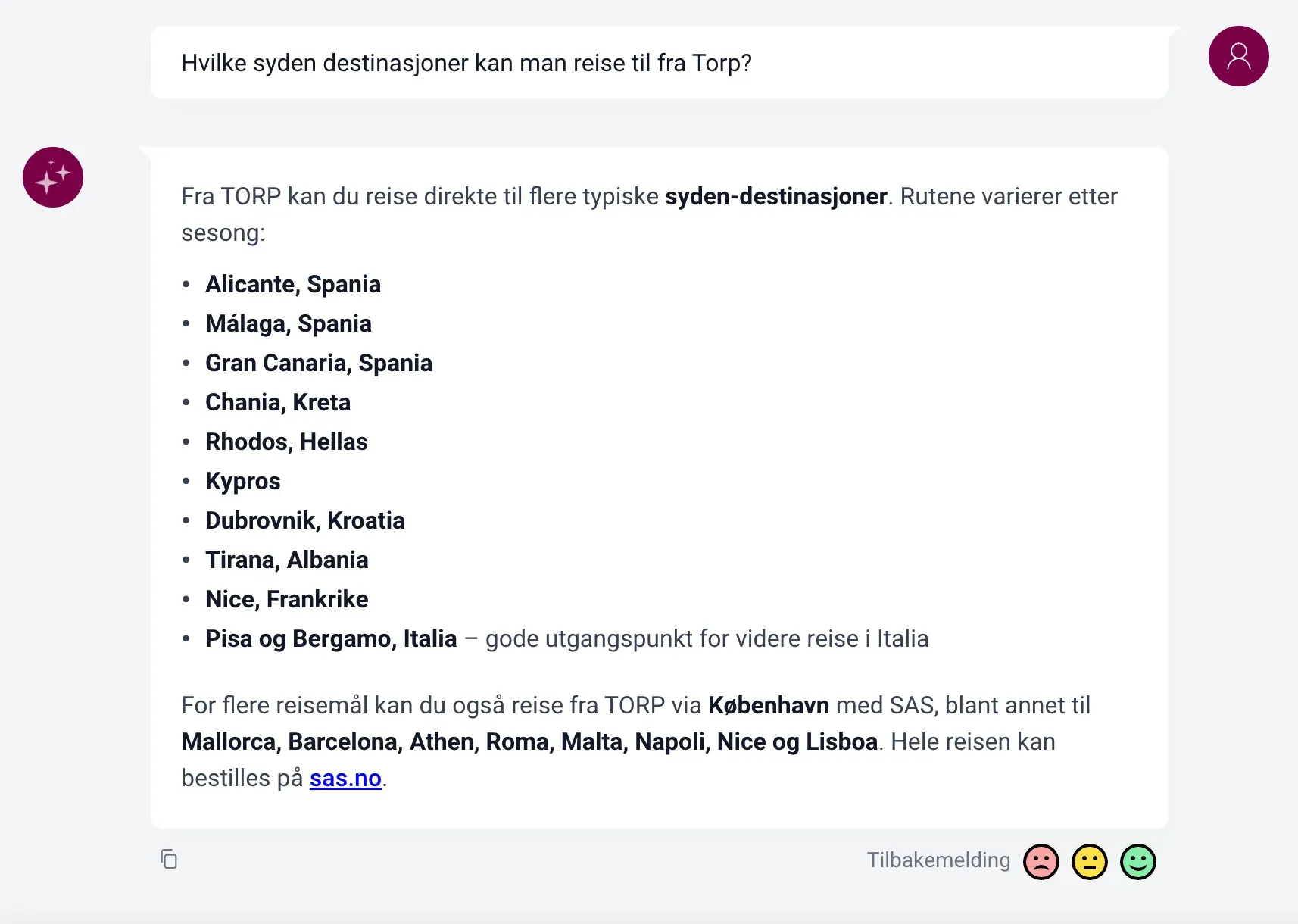
Asked «Hvilke syden destinasjoner kan man reise til fra Torp?» ("Which sun destinations can you travel to from Torp?"), TorpAI lists a number of destinations – including Alicante, Málaga, Gran Canaria, Chania on Crete, Rhodes, Cyprus and Dubrovnik – and points out that routes vary by season. For more destinations it also shows the route via Copenhagen with SAS, and links to sas.no for booking. This is knowledge that rarely changes, and it belongs in the knowledge base.
#Example 2: Status for one specific flight
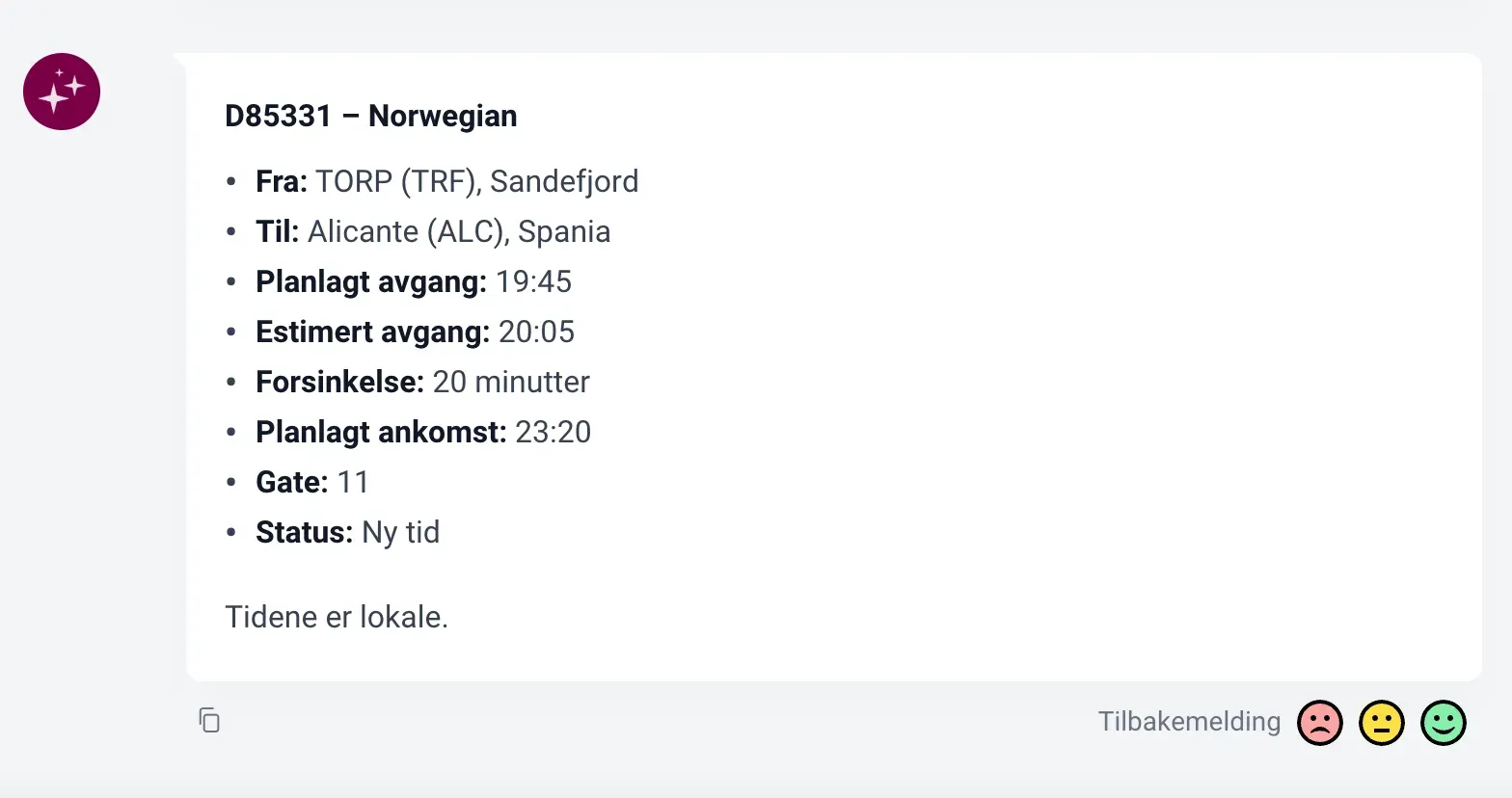
When the passenger asks about one specific flight, TorpAI answers with a complete status card: D85331 with Norwegian from TORP to Alicante, scheduled departure 19:45, estimated departure 20:05, a delay of 20 minutes, scheduled arrival 23:20, gate 11 and status «Ny tid» ("new time"). The assistant adds that the times are local. This is the information that changes along the way, and it is fetched via MCP the moment the question is asked.
#Example 3: Today's departures as a table
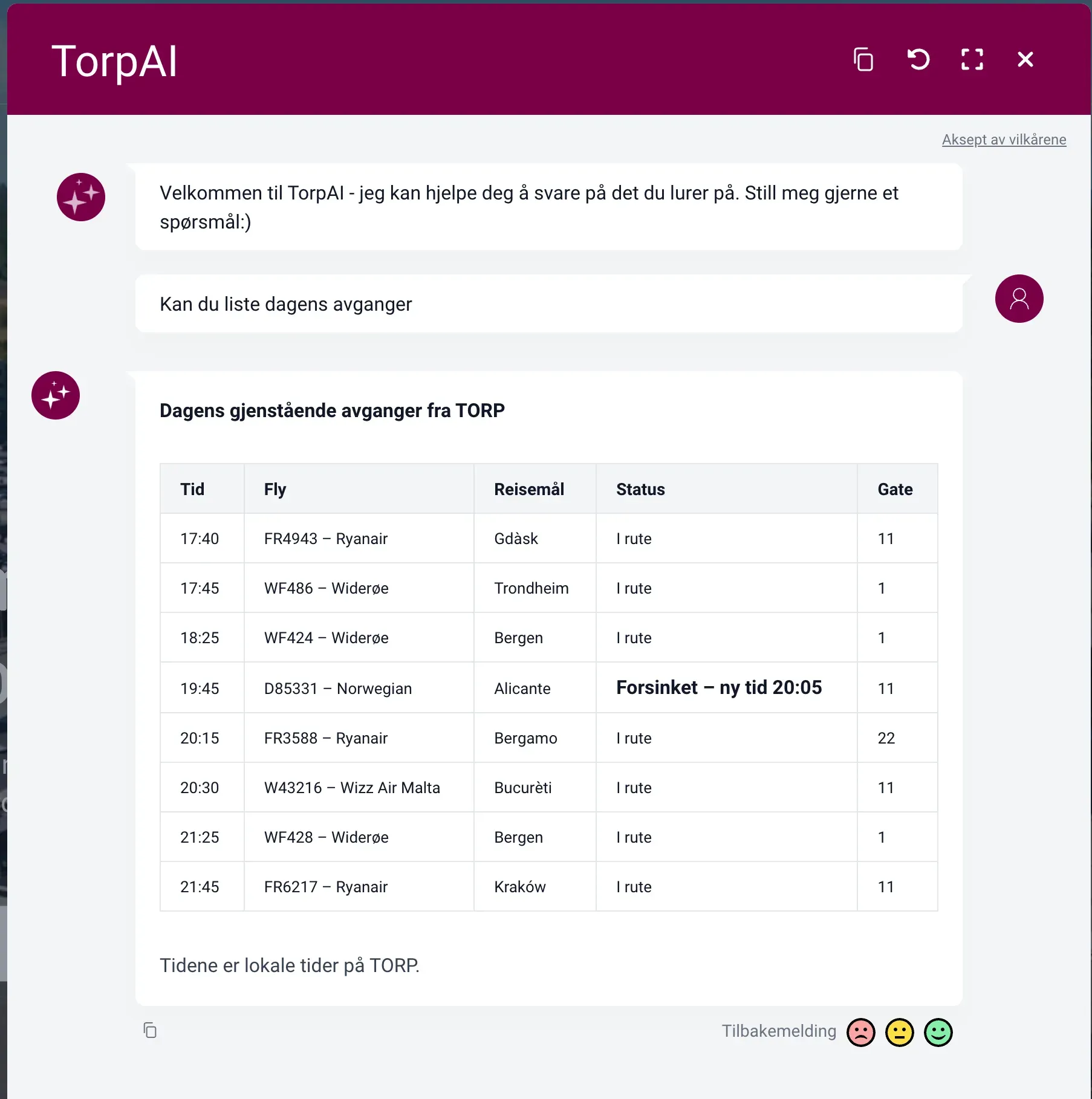
To «Kan du liste dagens avganger» ("Can you list today's departures") TorpAI answers with a table of today's remaining departures from TORP: time, flight, destination, status and gate. Delays are highlighted – here the flight to Alicante is marked «Forsinket – ny tid 20:05» ("Delayed – new time 20:05") – while the other departures show «I rute» ("On schedule").
#Example 4: A question about a specific date
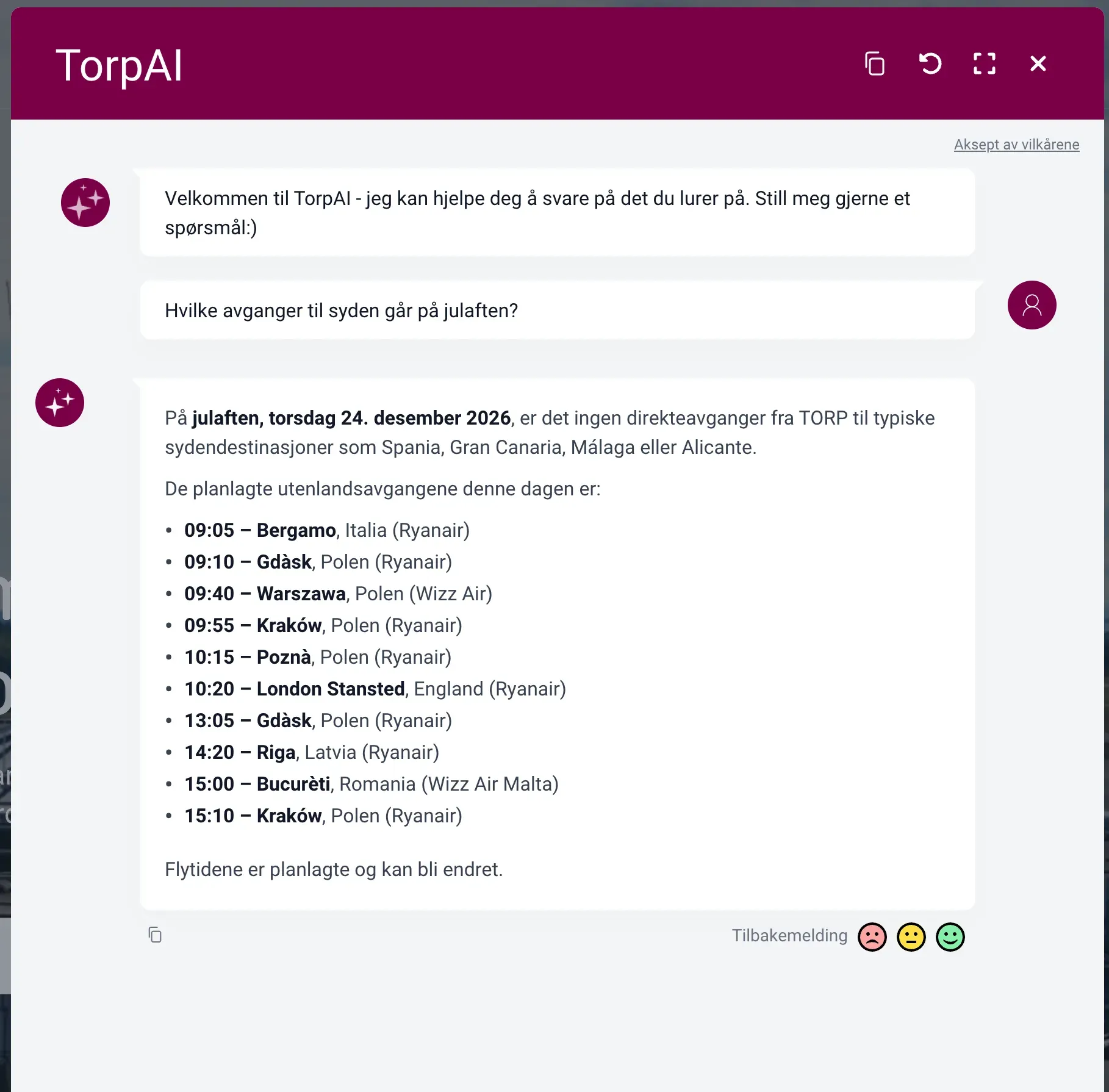
The question «Hvilke avganger til syden går på julaften?» ("Which departures to the south leave on Christmas Eve?") shows that the assistant understands dates. TorpAI works out that Christmas Eve is Thursday 24 December 2026, looks up the departures that day and answers that there are no direct departures to typical sun destinations. Instead it lists the scheduled international departures – including to Bergamo, Warsaw, Kraków, London Stansted and Riga – and reminds that the flight times are scheduled and may change.
There is no contradiction between this and the first example. The knowledge base says where you can travel during the year, while MCP says what actually flies on a given day. A good answer is an honest answer, not a guess.
#How it works
TorpAI is built on the coreAI platform, with Torp's own name, look and content. It uses two sources, and coreAI picks the right source for each question:
- The knowledge base holds what rarely changes, for example which destinations have routes. The answers are drawn from the airport's own content.
- MCP tools for flight data provide lookups such as departures, the status of one flight and departures on a specific date. The tools sit on an MCP server that gives the assistant access to the flight data.
When a passenger asks a question, coreAI enters agentic mode: the assistant judges whether the answer is in the knowledge base or needs real-time data, calls the right tool and formulates the answer in plain language – as a list, a status card or a table, depending on the question. The MCP server decides what the assistant is allowed to fetch, so access is controlled where the data lives. More in the articles on agentic mode and MCP.
#Why real time via MCP and not an imported copy
- Always up to date. There is no delay between a change in the flight data and the answer the passenger gets, and no synchronisation job that can stop.
- No copy to maintain. The flight data stays in the source system, and coreAI only reads it when someone asks.
- Always open and multilingual. The same setup answers around the clock and in several languages.
- No expensive custom integration. MCP is a standard way to connect AI to systems, so the same approach can be used against other data sources.
#How to get started
If you have data that changes quickly – flight departures, orders, appointments or stock levels – the pattern is the same: keep the data in the source system, build an MCP server that gives the assistant controlled lookups, and let the knowledge base handle the content that rarely changes. Start with a few read-only tools, such as status and lookups, before you open up for actions. See the agentic AI solution or get in touch to discuss an integration with your system.